


Analysts say crypto is falling due to overvalued markets, not real reasons or fundamentals. The sell-off may be nearing its end.
Crypto Market Leverage Impact is still falling and public trust is eroding, even though the economy remains stable.
The Kobeisi Letter states that there is no clear reason for this decline, and that crypto may be reaching its lowest point now.
Table of Contents
$1.1 Trillion Lost in a Month
Over the past 41 days, the crypto market has lost more than $1.1 trillion, meaning it has lost an average of $27 billion per day. The market cap is now about 10% below the record $19 billion liquidation on October 10.
Kobeissi analysts say this decline is structural, meaning the market structure itself is deteriorating, while crypto’s fundamentals remain largely unchanged.
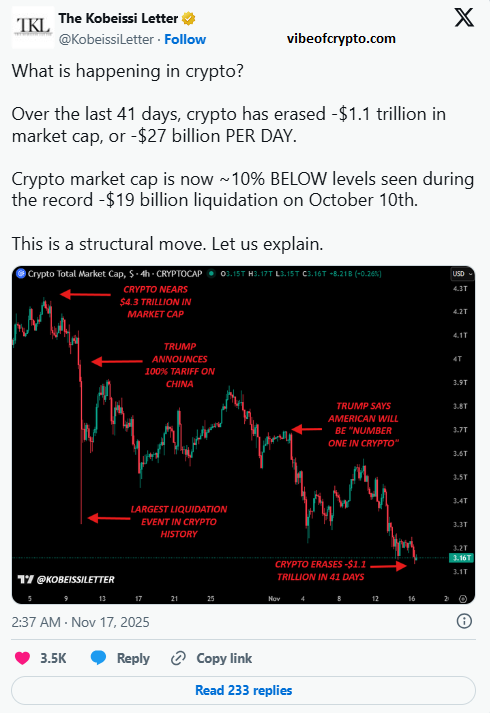
According to them, this decline is strange because there have been only a few negative developments in fundamentals.
Nevertheless, prices are falling rapidly. Bitcoin saw a 25% drop last month, even as US President Donald Trump said making America number one in crypto was his priority.
Leverage Impact Behind Downtrend
Analysts say leverage is accelerating the crypto market’s decline. As institutions withdrew money in mid- and late October, crypto investment funds saw outflows of $1.2 billion in the first week of November.
The problem is that these outflows coincided with excessive leverage. Crypto traders often use 20x, 50x, or even 100x leverage.
This creates a domino effect when prices fall, leading to aggressive selling. On October 10, forced selling reached $19.2 billion, leading to Bitcoins first $20,000 daily candlestick.
Over the past 16 days, the market has seen three separate days when liquidations exceeded $1 billion, especially when trading volume was low. This increased volatility and eroded public confidence. The Crypto Fear & Greed Index is now at Extreme Fear, matching the February 2025 lows.
Gold Diverges Bitcoin, ETH Hardest
Analysts say that Bitcoin and gold are now moving in different directions. For the past year, they were moving together, but since October, gold has outperformed BTC by 25%.
Ethereum has fallen even more. ETH has fallen 35% since October, which is more than a normal bear market. This is unusual because risk assets in global markets have been rallying broadly during this period.
This difference suggests that crypto is now in a “structural” bear market, while its fundamental value is improving.
Kobeissi analysts say: As with every efficient market, these problems will gradually resolve. We think the bottom is near.
Macro Signals Leverage Impact
Despite the sell-off, the macro environment remains supportive of risk assets, which has historically been positive for crypto.
Global money supply is still growing, with M2 reaching $137 trillion worldwide. Japan is set to provide more than $110 billion in stimulus, which could increase liquidity in global markets.
Households in the US will receive $2,000 tariff-related payments, which will boost their disposable income. Such relief measures also helped fuel the retail-driven crypto boom of 2020–2021.
Historically, crypto has tracked closely with global liquidity. Every major rally from 2013 to 2021 has been accompanied by an expansion of M2.
Why This Matters – Leverage Impact
If more money is flowing into the crypto market but prices are falling, it could mean that the crypto sell-off is due to market rules, not macro factors. This means that a market turnaround or recovery may come sooner than sentiment suggests.
- Bitcoin 107K Breaks Strong as Bulls Eye Big Win
- Trump Crypto ETF Targets BTC And ETH in 2025
- Metaplanet Bitcoin Purchase Sparks Explosive 1111 BTC Buy
- Hyperliquid Builder Codes Top $10M New Crypto Boom Coming?
- Bitcoin Hits $123K Ahead of Make-or-Break
- Stellar (XLM) Explained: Easy Guide for Beginners
- JPMorgan Launching Crypto-Backed Loans With BTC and ETH
- SYRUP Defies Market Trends After Upbit Listing
- SHIB Hype Fades While Remittix Rises as the Smarter Crypto Choice
- CryptoPunks NFT Sells for $2.5M as NFT Market Shows Fresh Momentum
- XRP Price Expansion Phase: Can Ripple Reach $7 in 2025?
- Cardano WLFI Stablecoin and Chainlink Partnerships
- Binance Futures Trading Paused: Market Prices Rattled
People Also Ask – Leverage Impact:
What effect does macro liquidity have on crypto?
Crypto prices historically tend to match global liquidity. When M2 money supply increases, stimulus is provided, and households‘ disposable income increases, this supports crypto bull cycles.
What does a structural bear market mean in crypto?
It refers to a prolonged decline that occurs due to internal market dynamics, such as leverage and liquidations, rather than fundamentals.
How does leverage affect crypto prices?
High leverage exacerbates market swings. When prices fall, leveraged positions are liquidated, creating a domino effect that pushes prices sharply lower.